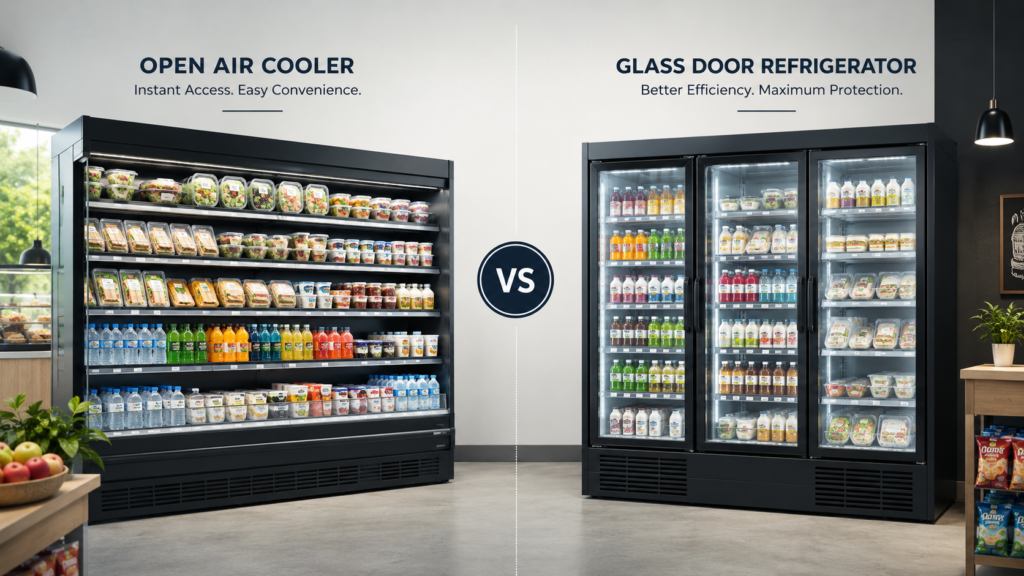
Which Is Better for Your Store?
Choosing between an open air cooler and a glass door refrigerator is more than a refrigeration decision. It can affect how customers interact with products, how much merchandise you can sell from a given space, your store’s energy consumption, and even shopper comfort.
Both types of commercial refrigeration are widely used in supermarkets, convenience stores, delis, cafés, grocery stores, and other retail environments. However, they solve the merchandising problem in very different ways.
An open air cooler, also called an open air merchandiser, air curtain merchandiser, or open display refrigerator, removes the physical barrier between the customer and the product. A glass door refrigerator keeps the refrigerated space enclosed while allowing customers to see the products through transparent doors.
So which one should you choose? The answer depends largely on what you sell, how customers shop, and how you balance merchandising performance against energy efficiency.
What Is an Open Air Cooler?
An open air cooler is a refrigerated display case with an open front rather than doors. Cold air is circulated through the cabinet and across the front opening, creating an air curtain that helps separate the refrigerated interior from the warmer surrounding environment.
These units are especially common for products customers are expected to grab quickly, including:
- Bottled and canned beverages
- Sandwiches and wraps
- Salads
- Dairy products
- Packaged meals
- Produce
- Desserts
- Grab-and-go foods
Open multi-deck merchandisers are extensively used for meat, deli products, cheese, beverages, produce, and prepared foods.
Their biggest advantage is simple: there is nothing between the shopper and the product.
Customers can see an item, reach for it, and put it in their cart without opening a door.
What Is a Glass Door Refrigerator?
A glass door refrigerator, often called a glass door merchandiser, uses transparent insulated doors to separate refrigerated products from the surrounding store environment.
Like open air coolers, these units are designed to display products rather than simply provide back-of-house cold storage.
Typical applications include:
- Soft drinks
- Water
- Energy drinks
- Beer
- Dairy products
- Packaged food
- Grab-and-go meals
- Convenience products
Manufacturers design commercial glass door merchandisers specifically around product visibility and retail merchandising. True Manufacturing, for example, describes its glass door merchandisers as equipment intended to showcase refrigerated products and encourage impulse sales.
The key difference is that shoppers must open a door before taking the product.
That small difference has major implications for both merchandising and refrigeration efficiency.
Open Air Cooler vs. Glass Door Refrigerator at a Glance
| Feature | Open Air Cooler | Glass Door Refrigerator |
|---|---|---|
| Customer access | Excellent | Very good |
| Product visibility | Excellent | Excellent |
| Impulse-buy potential | Excellent | Very good |
| Energy efficiency | Lower | Higher |
| Temperature isolation | More challenging | Better |
| Shopper interaction | No barrier | Door must be opened |
| Cold air loss | Higher | Lower |
| Best for | High-turnover grab-and-go | Beverages and general merchandising |
Neither format is automatically better. They are optimized for different retail priorities.
Open Air Coolers Offer Easier Customer Access
The strongest argument for an open air merchandiser is frictionless shopping.
There is no handle to pull and no door to hold. A customer walking past a refrigerated display can simply reach in and take an item.
That makes open displays especially attractive in environments where speed and impulse purchases matter.
Think about a café displaying sandwiches beside the checkout line or a convenience store selling ready-to-eat meals. Removing one small interaction from the purchase process can make the display feel more accessible.
Open cases also provide a broad, uninterrupted view of shelves. Retailers can create highly visible merchandising walls with multiple shelf levels facing directly toward the customer.
For this reason, open air refrigeration is particularly well suited to grab-and-go merchandising.
Glass Door Refrigerators Are Usually More Energy Efficient
The major disadvantage of an open display is also obvious: the refrigerated space is exposed to the store.
An open air merchandiser relies on carefully controlled airflow to maintain product temperatures while the front remains open. But warm store air can still enter the refrigerated zone.
The U.S. Department of Energy reports that, in open vertical medium-temperature refrigerated display cases, more than 80% of the cooling load can be associated with infiltration of surrounding air. DOE also notes that this design can spill cold air into shopping aisles, affecting shopper comfort.
Doors dramatically reduce this exchange between refrigerated and ambient air.
Historical DOE research found that open refrigerated display cases could consume up to three times the energy of similarly configured cases with doors. Actual energy use varies significantly by case design, store conditions, product load, door technology, refrigeration system, and operating practices, so this should not be treated as a universal three-to-one rule.
Modern glass door refrigeration can therefore offer a substantial operating-cost advantage, particularly in stores with long operating hours or large refrigerated lineups.
ENERGY STAR also maintains efficiency specifications and certified product listings for commercial transparent-door refrigerators and freezers.
What About Product Visibility?
One common concern about adding doors is that they may make products less accessible or reduce impulse purchases.
There is some logic to that concern. Open cases eliminate every physical barrier to the product.
However, modern glass door merchandisers are specifically designed to preserve visibility. Large transparent doors, LED lighting, narrow frames, and organized shelving can create a highly effective retail display.
Some modern glass door cases can also provide impressive merchandising capacity. Hillphoenix, for example, states that one of its glass door reach-in designs consumes less than half the energy of a comparable open multi-deck case while offering greater pack-out within the same footprint. That is a manufacturer-specific comparison rather than a rule for every refrigerator, but it illustrates how much closed-case design has evolved.
The question is therefore not simply visibility versus efficiency.
It is more accurately:
Does removing the door create enough merchandising value to justify the additional refrigeration load?
Temperature Stability and Store Environment Matter
Open air coolers are more sensitive to their surroundings because their performance depends heavily on maintaining the designed airflow pattern.
Poor placement or operating conditions can interfere with the air curtain.
Problems may arise from:
- HVAC drafts
- High humidity
- Excessive ambient temperatures
- Blocked air returns
- Improperly stocked shelves
- Direct sunlight
- Nearby doors or strong airflow
DOE energy guidance for retail food facilities specifically recommends keeping airflow paths in refrigerated cases clear and covering open refrigerated cases when stores are closed.
Glass door units have a physical barrier separating refrigerated products from these environmental conditions, making them generally less exposed to changes in the surrounding retail space.
Which One Is Better for Your Store?
Choose an open air cooler when:
- Fast customer access is a major priority.
- You sell high-turnover grab-and-go products.
- The display plays an important role in impulse purchasing.
- You want an uninterrupted merchandising presentation.
- Products need to be extremely easy to pick up.
Choose a glass door refrigerator when:
- Energy efficiency is a major priority.
- The equipment operates for long hours.
- You sell beverages or packaged refrigerated products.
- Maintaining a more isolated refrigerated environment is important.
- You have a large refrigeration lineup where operating costs can accumulate quickly.
Many successful retail environments use both.
A grocery store might use open multi-deck cases for produce, prepared meals, and grab-and-go foods while using glass door merchandisers for beverages, dairy products, and other packaged items.
The equipment should follow the way the product is actually purchased.
The Bottom Line
There is no universal winner in the open air cooler vs. glass door refrigerator comparison.
Open air coolers prioritize accessibility and merchandising. They remove the barrier between the customer and the product, making them particularly effective for grab-and-go and impulse-driven retail environments.
Glass door refrigerators prioritize thermal separation and energy efficiency while still providing excellent product visibility.
For many retailers, the decision ultimately comes down to one question:
Is unrestricted product access valuable enough to justify the additional energy required to maintain an open refrigerated display?
If the answer is yes, an open air merchandiser can be an excellent sales tool. If operating efficiency and controlled refrigeration are higher priorities, a glass door refrigerator will usually be the stronger choice.
The best retail refrigeration strategy is not simply about keeping products cold. It is about matching the refrigeration system to how customers see, select, and buy those products.